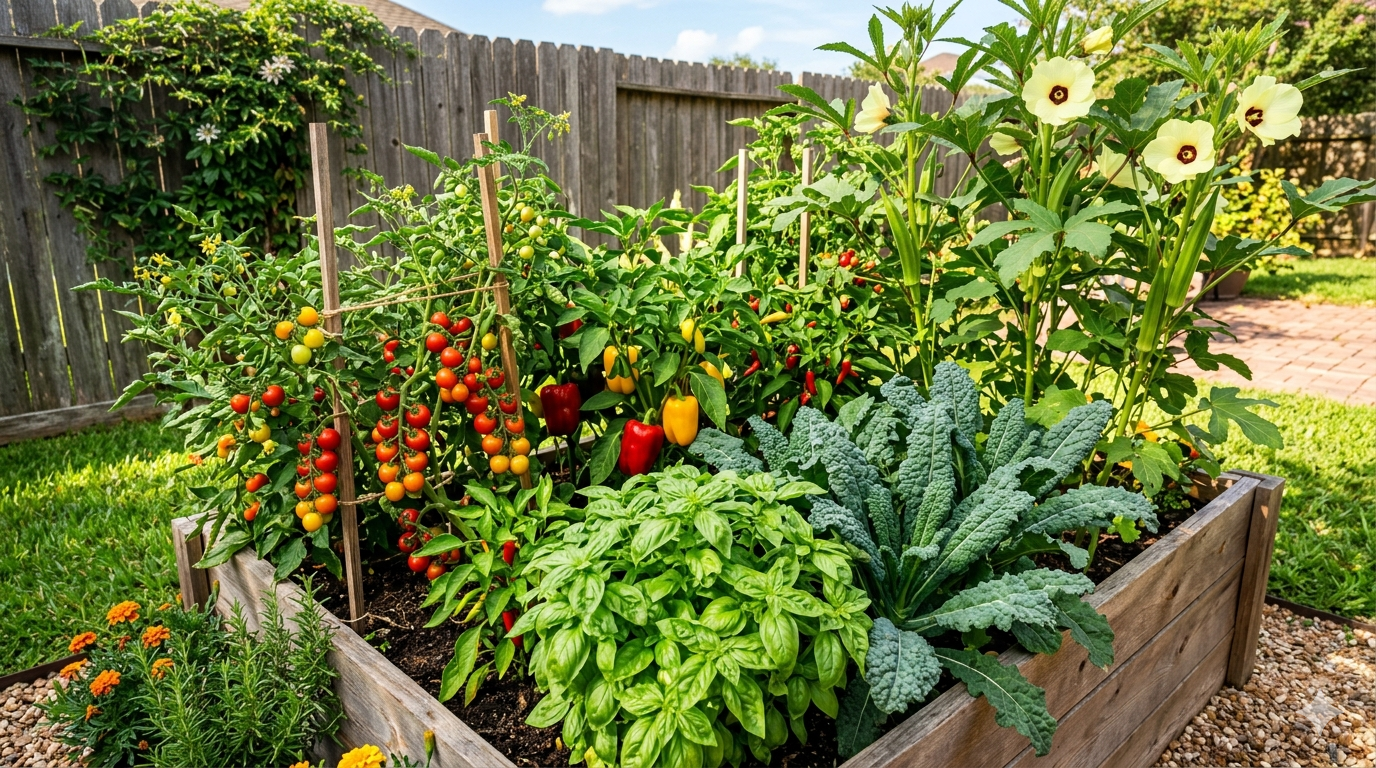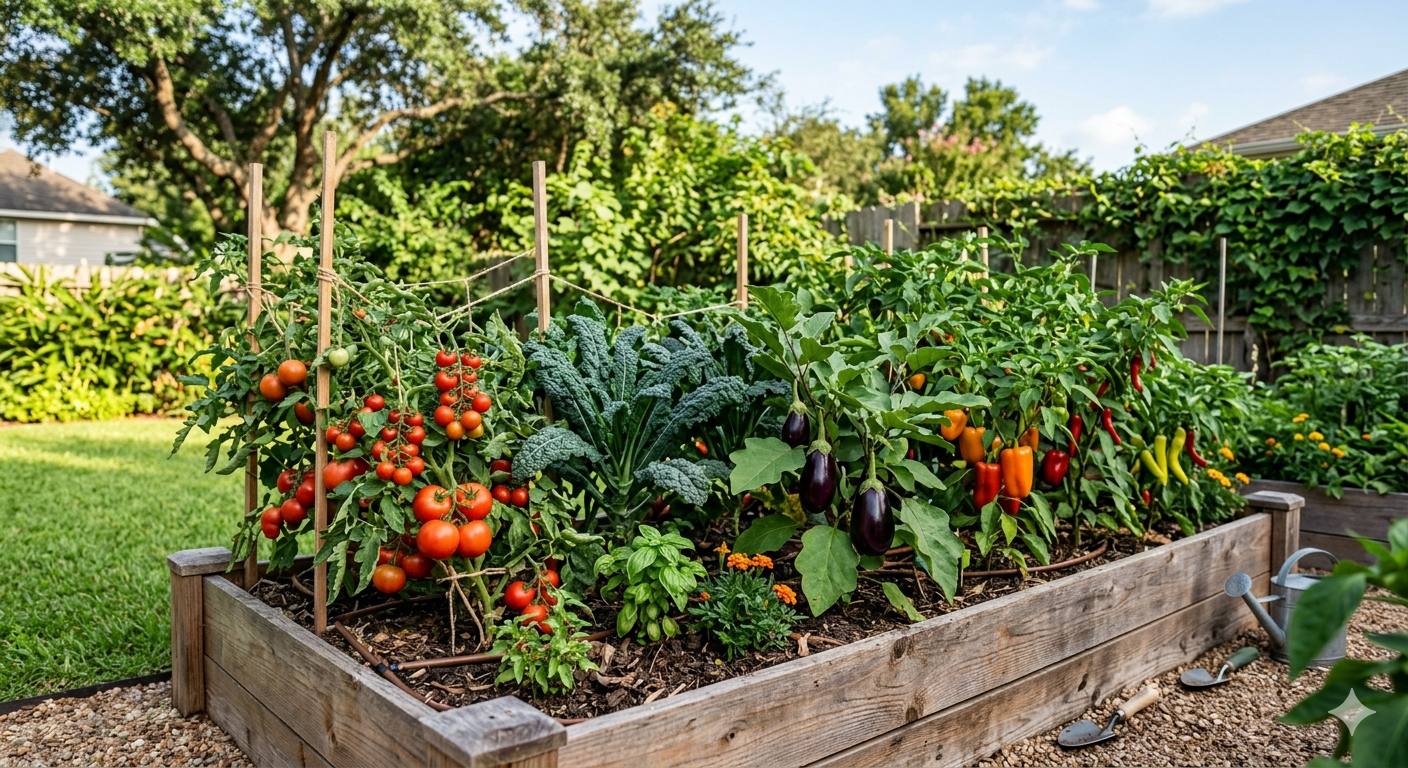
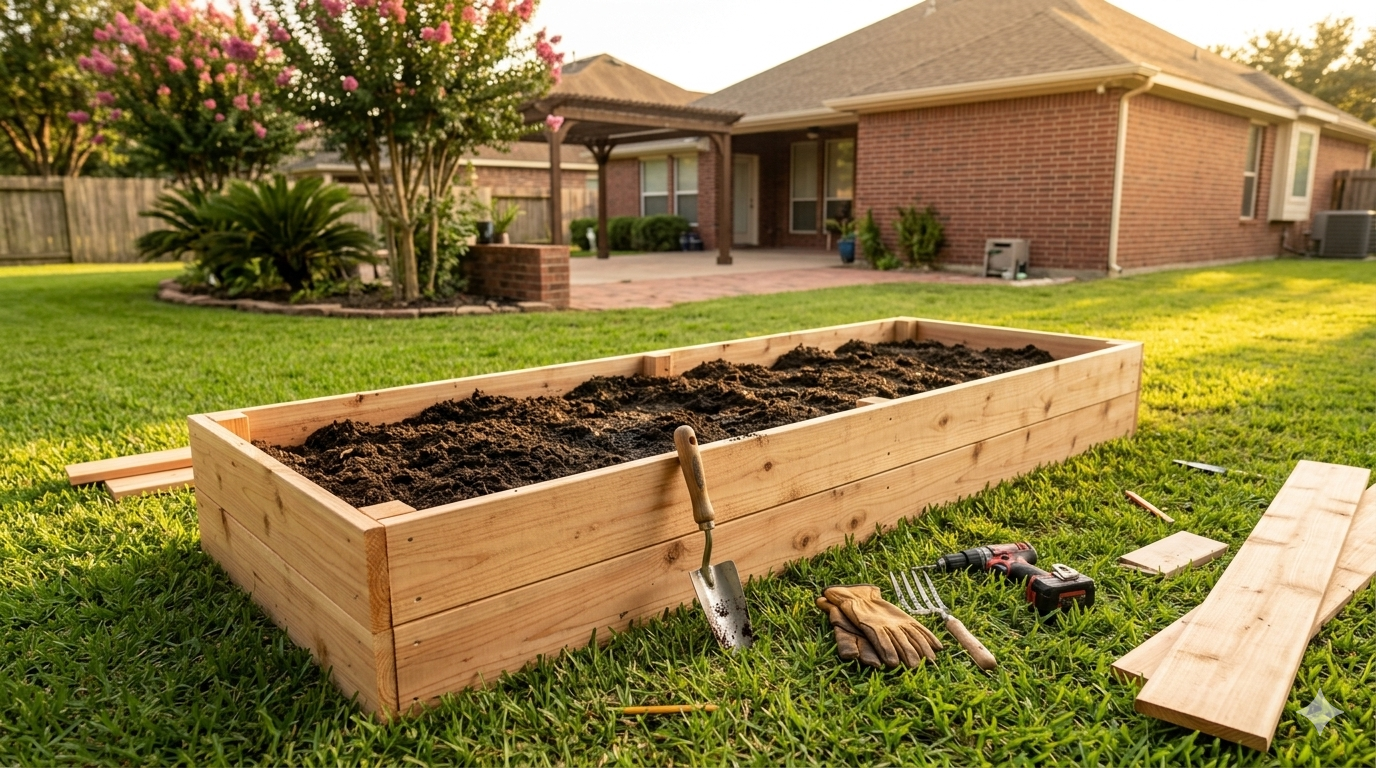
If you’ve tried growing vegetables in Houston’s native soil and come away frustrated, you’re not alone. Our heavy clay soil drains poorly, compacts easily, and makes root development a constant battle. It’s not that Houston can’t grow food — it absolutely can. But the soil needs help.
That’s where raised beds come in. A raised bed garden in Houston isn’t just a nice-to-have. For most homeowners, it’s the difference between a productive edible garden and a failed one. At EcoTerra Edible Landscapes, almost every edible garden we design and build incorporates raised beds for exactly this reason.
This guide walks you through everything you need to build a raised bed garden in Houston — the right materials, the right soil mix, the right size, and the placement decisions that set you up for long-term success.
Why Raised Beds Work So Well in Houston
Houston’s clay soil has two major problems for vegetable gardening:
- Poor drainage — clay holds water, which suffocates roots and invites fungal disease
- Compaction — clay packs down under foot traffic and rainfall, preventing root penetration
Raised beds solve both problems completely. You’re not fighting the native soil — you’re building above it with a custom blend designed for drainage, aeration, and nutrients. The result is a growing environment that plants love, even when the ground beneath it is solid clay.
Beyond soil quality, raised beds offer several other advantages specific to Houston:
- Soil warms up faster in spring, extending your growing season
- Defined beds prevent grass and weeds from encroaching
- Easier to manage pests and amend soil each season
- Elevated surface means less bending — more comfortable to maintain
- Better water control — you water the bed, not the surrounding area
Step 1: Choose Your Location
Before you build anything, location is the most important decision you’ll make. Vegetables need sunlight — most require a minimum of 6 hours of direct sun per day, and 8+ hours produces the best results.
What to Look For
- Full sun for at least 6 hours (8+ is ideal for tomatoes, peppers, and squash)
- Reasonably level ground — a slight slope is fine, but avoid low spots where water pools
- Close to a water source — you’ll be watering often, especially in Houston summers
- Away from large trees — tree roots compete for water and nutrients, and canopy blocks sun
What to Avoid
- Areas shaded by your house in the afternoon — morning sun with afternoon shade is acceptable, but full afternoon shade is not
- Low spots where water collects after rain — even raised beds can be undermined by poor drainage around them
- Areas directly under or near large oak, pecan, or pine trees
Take note of sun patterns across your yard at different times of day before committing to a location. What looks sunny at 9am may be shaded by 1pm.
Step 2: Choose Your Bed Materials
The material you build with affects cost, longevity, and aesthetics. Here are the most common options for a raised bed garden in Houston:
| Material | Lifespan | Notes |
| Cedar | 10–15 years | Best all-around. Naturally rot-resistant, looks great, safe for edibles. |
| Redwood | 15–20 years | Excellent durability. More expensive and harder to source in Houston. |
| Pine (untreated) | 3–5 years | Budget option. Degrades faster in Houston humidity. |
| Galvanized Steel | 20–30+ years | Modern look, very durable. Gets hot in summer — use thicker soil to insulate roots. |
| Concrete Block | Permanent | Very durable. Labor-intensive to build. Works well for permanent installations. |
| Treated Lumber (AC2) | 15–20 years | Modern pressure treatment is considered safe for edibles. Avoid older CCA-treated wood. |
At EcoTerra, we most commonly use cedar or galvanized steel for client builds. Both hold up well in Houston’s heat and humidity and look attractive in an edible landscape design.
Step 3: Determine Size and Height
Width
The most important dimension is width — you should be able to reach the center of the bed from either side without stepping in. That means:
- 4 feet wide maximum if accessible from both sides
- 2–3 feet wide if accessible from one side only (against a fence or wall)
Stepping into a raised bed compacts the soil and defeats the purpose of building one. Design the width around your reach, not your available space.
Length
Length is flexible — 4×4, 4×8, and 4×12 are all common. Longer beds give you more growing space but require more materials and soil. For most Houston homeowners starting out, a 4×8 bed is a great first build — manageable, affordable, and productive.
Height
Height matters more in Houston than in most climates because of our clay soil. Recommendations:
- Minimum 10–12 inches for most vegetables
- 18–24 inches for root vegetables like carrots and sweet potatoes
- 12 inches is the sweet spot for most first-time builds — deep enough to matter, manageable to fill
Taller beds also drain better and are easier on your back. If budget allows, go with 12–18 inches.
Step 4: Prepare the Ground Underneath
Before filling your bed, address what’s underneath it — especially if you’re placing it over grass or weeds.
- Mow or cut down any existing vegetation as short as possible
- Lay cardboard directly on the ground inside the bed footprint — this kills grass and weeds through a process called sheet mulching
- Overlap cardboard edges by at least 6 inches so nothing grows through the seams
- Wet the cardboard thoroughly before adding soil — this starts the decomposition process and keeps it from blowing around
- Fill with your soil mix directly on top of the cardboard
The cardboard will break down within a season, at which point your plant roots can grow into the native soil below if they want to. By then the grass and weeds are dead and the clay has begun to loosen slightly from root activity above it.
Step 5: Build the Right Soil Mix
This is where most DIY raised beds go wrong. Native Houston soil should not go inside your raised bed — even mixed with amendments, it will compact and drain poorly. You want a purpose-built mix.
A tried-and-true mix for raised bed gardens in Houston:
- 60% high-quality topsoil or compost-based garden mix
- 30% compost (mature, dark, crumbly — not unfinished)
- 10% expanded shale (haydite) for permanent drainage improvement
Avoid straight potting mix for large raised beds — it’s too lightweight, dries out too fast, and gets expensive at scale. The blend above gives you structure, nutrients, and drainage in the right balance for Houston’s climate.
How Much Soil Do You Need?
Calculate volume: Length (ft) x Width (ft) x Height (ft) = cubic feet. Divide by 27 for cubic yards.
Example: A 4×8 bed at 12 inches deep = 4 x 8 x 1 = 32 cubic feet = 1.2 cubic yards.
Order slightly more than you calculate — soil settles after watering. For a 4x8x12″ bed, order 1.5 cubic yards to be safe.
Step 6: Add Mulch on Top
Once your bed is filled and planted, apply a 2–3 inch layer of mulch on top of the soil around your plants. In Houston’s summer heat, mulch is not optional — it:
- Reduces soil temperature by up to 10°F
- Retains moisture so you water less frequently
- Suppresses weeds that would otherwise compete with your plants
- Breaks down over time and adds organic matter to the soil
Hardwood mulch, pine bark, or straw all work well. Avoid dyed mulches — stick to natural materials in a food garden.
Step 7: Set Up Irrigation
Houston summers are brutal, and hand-watering a raised bed every day is unsustainable. A simple drip irrigation system connected to a timer is one of the best investments you can make in your raised bed garden.
- Drip lines deliver water directly to the root zone — more efficient than overhead watering
- A basic timer runs $20–40 and eliminates the daily watering routine
- Soaker hoses are an even simpler option for a single bed
Water deeply and less frequently — aim for 1–2 inches per week. Deep watering encourages roots to grow down rather than staying shallow near the surface.
Want It Done Right the First Time?
Building a raised bed garden in Houston is absolutely a DIY project — but it’s also one where the details matter. The wrong soil mix, wrong location, or wrong materials can mean a frustrating first season and an expensive redo.
EcoTerra Edible Landscapes designs and builds custom raised beds for Houston homeowners. We handle everything — site assessment, materials, soil mix, installation, and planting guidance — so your bed is ready to produce from day one.
→ Explore our Custom Raised Beds service → Book a Coaching & Consulting session to plan your build → Read: Top 10 Edible Plants That Thrive in Houston’s Climate